
Free game · Ages 4–11
Jigsaw Puzzle
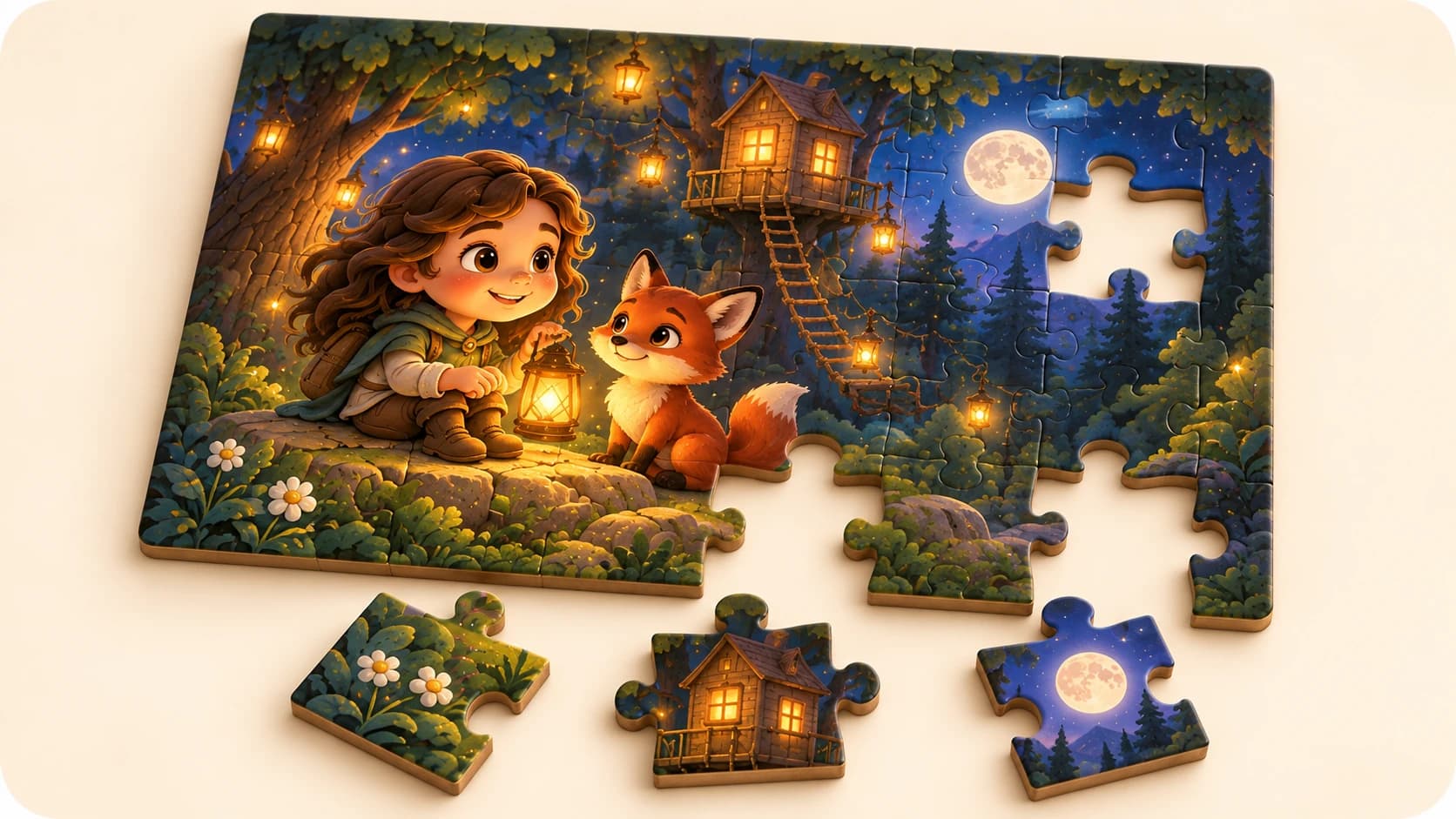
Bring your favourite story pictures together, one piece at a time. Choose a picture from your story library or try the included puzzle, then pick 4, 9 or 16 pieces to suit your mood. Drag each piece into place, or tap a piece and then its space. Need a little help? Peek at the complete picture whenever you like. Your progress is saved on this device, so you can take a break and come back to finish your puzzle.
Play in the MyStoryWorld.app mobile app. Progress stays on your device.
Learning through play
Every game is a chance to explore. Here are some of the skills your child can practise along the way.
- Spatial thinking
- Working out where a piece belongs gives children practice noticing shapes, edges and how small parts make a whole picture. (Levine et al., 2012)
- Attention to detail
- Following a colour, a line or part of a character encourages children to look closely and compare visual clues. (Center on the Developing Child, 2014)
- Problem-solving and persistence
- Trying a space, noticing what fits and choosing another approach offers a gentle opportunity to practise solving a problem step by step. (Center on the Developing Child, 2014)
- Talking and playing together
- Sharing the puzzle with a grown-up creates chances to use words such as corner, edge, above and beside, and talk about the story picture. (Pruden et al., 2011)
How to play
Turn the pictures in your story library into traditional jigsaw puzzles. An included picture means you can start playing even before you add your first book.
- Add Jigsaw Puzzle to your account on this website, then open Worlds → Games in the MyStoryWorld.app mobile app using the same account.
- Choose the included picture, or choose a book and a picture from your eligible story library. You can play the included puzzle without owning a book.
- Choose 4, 9 or 16 pieces. Every picture is available at every difficulty, so start with the amount that feels comfortable.
- Swipe the row of loose pieces beneath the board to find a piece. Briefly hold it, then drag it to its space. You can also tap a piece and then tap its space on the board.
- Use Show picture whenever you want to see the complete illustration. Close the picture to return to the same puzzle.
- Fit every piece to finish the picture and enjoy the celebration. Choose another picture, try a different piece count or replay a favourite.
Players & modes
- One player
- Complete the picture at your own pace. There is no opponent or race to finish.
- Enjoy it together
- A parent, sibling or friend can sit alongside and help spot clues or take turns placing pieces. This is shared play within the solo puzzle, rather than a separate two-player mode with scores.
Choose your challenge
- 4 pieces · A gentle start
- A 2 × 2 puzzle with four large pieces. A suggested starting point around age 4, or whenever your child wants a smaller challenge.
- 9 pieces · More to discover
- A 3 × 3 puzzle with more edges and picture details to match. A suggested starting point for ages 5–7.
- 16 pieces · A bigger challenge
- A 4 × 4 puzzle with more pieces to compare and place. A suggested starting point for ages 8–11. All three choices stay available, whatever your child’s age.
The rules
- Each piece has one correct place. A correct placement stays on the board; a piece placed in the wrong space returns to the tray so you can try again.
- Pieces are already the right way up. You do not need to rotate or flip them, and placed pieces do not swap positions.
- There is no timer, no lives to lose and no penalty for trying a piece in a different place.
- Show picture is available as often as you like. The Picture clue switch in the pause menu lets you show or hide the faint guide beneath the pieces.
- You can pause and return to a saved puzzle on the same device. Included pictures and story pictures already available on your device can be used offline.
Scores & progress
- The goal is to complete the picture. Jigsaw Puzzle does not award points, rank players or keep a fastest-time score.
- Completed pictures and unfinished puzzles are tracked separately for 4, 9 and 16 pieces. Trying a different count gives you another puzzle without replacing progress at the previous count.
- Each finished picture earns a celebration. Completing all the pictures in a book at one piece count earns that book’s completion celebration; each difficulty has its own progress.
- Progress stays with the signed-in account on the device where you play. It does not transfer between devices.
Selected references
These sources inform the learning-through-play ideas above. They discuss general play and development; they have not evaluated the MyStoryWorld.app games.
- Levine, S. C., Ratliff, K. R., Huttenlocher, J., & Cannon, J. (2012). Early puzzle play: A predictor of preschoolers’ spatial transformation skill. Developmental Psychology, 48(2), 530–542.
An observational study linked early physical puzzle play with later spatial skills. It does not establish that playing a digital jigsaw causes developmental gains.
- Center on the Developing Child at Harvard University. (2014). Enhancing and Practicing Executive Function Skills with Children from Infancy to Adolescence: Activities for 5- to 7-year-olds (pp. 8–9).
Practical guidance describes remembering card locations, following game rules, planning and solving puzzles as opportunities to practise skills. Our examples apply that guidance to the game’s activities; this is not a study of this app.
- Pruden, S. M., Levine, S. C., & Huttenlocher, J. (2011). Children’s spatial thinking: Does talk about the spatial world matter? Developmental Science, 14(6), 1417–1430.
This longitudinal study found associations between spatial language and later spatial skills. It provides context for talking about shapes and positions together, rather than proof of an effect from this game.